
News
Here you will find news of projects, publications and other exciting things being done by people across the network. If you have news to add, let us know by email ([email protected])

Forgan Arts Centre – Tidal Vessels Workshop
Last Saturday I had the pleasure of attending a workshop at Forgan Arts Centre, a local treasure trove of community centred creativeness, located right here in Fife.
The workshop was run by their current resident artists Caitlin and Anj Webb-Ellis, who were collaborating with choreographer Lucy Suggate and visual artist Charlie Ford for this event. The workshop delivered was a creative exploration of our relationship with landscape, particularly with the River Tay. It allowed us to sculpt our individual pieces of rock, from paper and granite, a process that felt individual but also highly collaborative at the same time. With an aim of bringing people closer to the local landscape and environment, we spent time becoming familiar with our materials, scrunching, folding, crumpling, smoothing. The processes felt reflective, as if we were becoming part of something as old as time itself.
For anyone who is interested in expanding into a more experimental realm of their research or you are simply wanting a chance to create, Forgan Arts Centre run regular events, workshops and garden projects. There is a strong community feel here and a dedication to socially engaged projects. Mending workshops and working with natural materials such as willow, are just some of the classes that I think would be of interest to all environmental humanities enthusiasts.
Thank you all,
Rachel
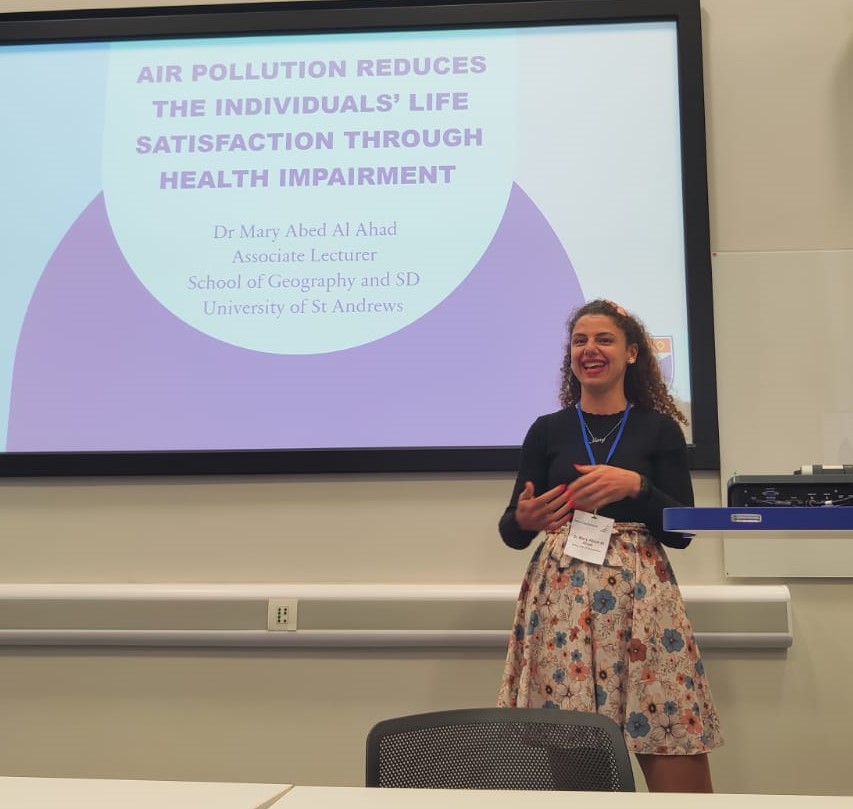
Research Spotlight Feature: Dr. Mary Abed Al Ahad
Our research spotlight feature for the month of December is Dr. Mary Abed Al Ahad, associate professor in the school of Geography and Sustainable Development. Find out about their work here.
Q. Tell us about your work and its connection to the Environmental Humanities.
“My work sits at the intersection of environmental science, public health, geography, and social justice. I study how environmental risks—particularly air pollution and climate-related stressors—shape health, well-being, and inequality across populations, with a strong focus on ethnic minorities and migrant communities. Through this lens, my research connects directly to the Environmental Humanities by highlighting the lived experiences, structural vulnerabilities, and ethical dimensions of environmental exposure, and by situating environmental health within broader questions of social inequalities, community resilience, and human–environment interactions.”
Q. What is your current research work focused on – any forthcoming papers or conferences.
“I am currently working on projects examining environmental and social determinants of health, immigrants’ life-course trajectories, and climate–well-being interactions. Forthcoming outputs include papers on the social and environmental determinants of life satisfaction and on the relationship between obesity, well-being, immigration, and climate. These outputs are planned to be presented at the upcoming Population Association of America (PAA) conference in May 2026 and at the European Population Conference (EPC) in June 2026.”
Q. What is your collaboration dream through the network? e.g. what areas of your work would you love to collaborate on with other colleagues in the Network, if any?
“I would love to collaborate with colleagues who work on environmental and social inequalities, community-engaged research, immigration studies, and climate inequalities. I am especially keen to connect my quantitative spatial and demographic analyses with humanities-based approaches that centre narratives, lived experience, ethics, and cultural responses to environmental harm. Collaborations that blend empirical evidence with creative, participatory, or interpretive methods would be particularly exciting.”
Q. Are there other professional bodies you are part of that you would recommend or like to highlight to colleagues in the EnvHum Network?
“My work is connected with networks such as the Scottish Alliance for Geoscience, Environment and Society (SAGES), the British Society for Population Studies, and the Max Planck Institute for Demographic Research. These organisations offer excellent spaces for interdisciplinary dialogue between environmental scientists, social scientists, and humanities scholars.”
Q. What events would you like to see organised through the Network?
“I would welcome events that foreground interdisciplinary conversations—for example- workshops blending quantitative environmental data with humanities-driven interpretive approaches; panels on environmental and social inequalities, lived experience, and storytelling; skill exchanges (e.g., narrative methods, participatory environmental mapping, arts-based climate communication, quantitative methods for social scientists); collaborative writing retreats; cross-sector dialogues with policymakers and community organisations. Events that create space for early-career scholars to build meaningful interdisciplinary partnerships would be particularly valuable.”
Find more about Dr. Mary Abed Al Ahad’s work here.
2025-2026 Environmental Humanities Intern Introduction
A short post to introduce myself as the new Environmental Humanities intern. My name is Rachel Cronin and I’m a postgraduate student in the Interdisciplinary school studying Global, Social and Political Thought.
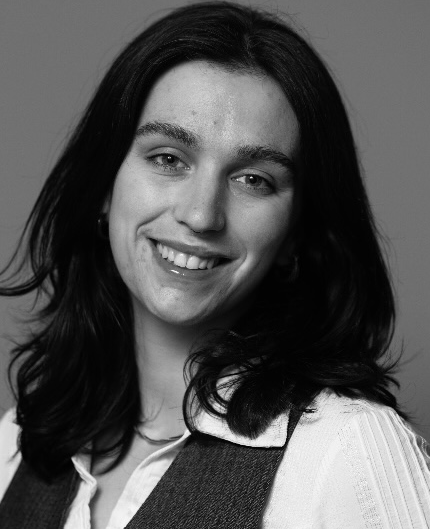
My undergraduate studies in human geography and archaeology at Trinity College Dublin, introduced me to the world of interdisciplinary studies as I learned how valuable merging information can be, to create impactful change. I became interested in the sociological elements to archaeological practice, especially considering the role landscape plays for self- identity and community. I have taken a keen interest in the environmental contributions to community; particularly how marginalised communities face higher concentrations of issues relating to climate change. The MLitt at St Andrews is the perfect course for me to continue developing my cross-disciplinary interests, and I hope to focus my future research on the relationship communities who have experienced colonisation have with the landscape. In particular, I am interested in how language and storytelling reveal this relationship, but also in how local biodiversity relates to this field in a way that encourages the resurfacing of lost memory.
I would love to hear from anyone who explores environmental topics, climate change, nature and so forth in innovative ways. I would also love to collaborate with staff and students who enjoy merging their academic research field with areas of creativity such as art, creative writing and any peculiar skills or hobbies!
I am very interested in expanding the Environmental Humanities department into the wider community, to develop a relationship with the locality as I really feel this could benefit everyone, to have a better understanding of the local biodiversity and landscape.
I believe there is an abundance of local knowledge to be discovered about St Andrews and Fife. By involving the local experts in what we do, whether they are artists, creatives, or researchers, we can uncover a wealth of knowledge that in turn can act as inspiration to our research. I feel this will be especially valuable to students who are still finding their chosen path of interest.
Corrour X St Andrews research opportunities
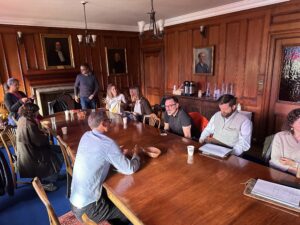
Members of the Corrour X St Andrews partnership research board spent the day visiting colleagues and facilities at Eden Campus and in St Andrews ahead of the board meeting on Friday, August 29.
The partnership, which was officially launched last year, has seen several research projects get underway at Corrour from the Schools of Philosophy, Computer Science, and Anthropology, among others. The board’s role is to review research proposals to determine compatibility with the joint aims of the partnership.
The visit included a presentation to the Environmental Humanities Network and the Sustainable St Andrews Academic group where colleagues learned about the research proposal submission process and discussed ideas for future field work at Corrour.
Also on the board is St Andrews alumna and partnership lead from Corrour, Charlie Davis who serves as the first point of contact for colleagues wishing to submit a research proposal. “As an alumna, it is a privilege to now lead the Corrour X St Andrews Partnership. My role is to create links between the University’s academic expertise and Corrour as a landscape, a business and a community. As a Board we want to create opportunities for research that is ambitious, collaborative, and addresses real-world challenges,” Charlie said.
“Next year, we will welcome researchers and students to a brand-new bespoke research centre at Corrour with 24 beds, a field laboratory, and conference facilities— built using our own timber. Nestled within Corrour’s dramatic landscape, it will be a place to base field research, teaching, collaborate and learn while experiencing the Scottish Highlands first-hand.”
The full board, representing both institutions, are: Charlie Davis (Partnership Lead and Board Chair), Donald Rowantree (Corrour Estate Manager), Jonny Hughes (Executive Board Member & Chair of Corrour Environmental Committee), Sarah Watts (Conservation Manager), Professor Gareth Miles (AVP Dean of Science), Professor Catherine O’Leary (AVP Dean of Arts and Divinity), Keith Thomason (Sustainability Integration Manager), Dr Katherine Roucoux (Senior Lecturer, School of Geography and Sustainable Development), Dr Iain Matthews (Senior Lecturer, School of Biology), and Karen Laing (Director of Sustainability Transformation (St Andrews Lead).
To learn more about the partnership and research proposal submission process, please visit The St Andrews Forest website.
Knotted Survivors: Documenting the Ancient Khipu Traditions of Jucul, Peru.
A new grant has been awarded to Professor Sabine Hyland, School of Divinity, from the British Museum Endangered Material Knowledge programme
“This project will document and preserve the ancestral khipus (knotted cord writing) of the remote highland community of Jucul, Peru. Khipus, an Andean form of record keeping, were central to Inca modes of knowledge, yet are little understood. It was thought that, except for simple herding cords, khipu use died out after the Spanish conquest in the 1500s. In the 20th century, however, anthropologists discovered that khipus were used in two Peruvian villages until the 1950s; I have encountered three additional communities where khipus continue to play a vital role. Villagers’ memories of how khipus were utilised have led to insights into how ancient khipus functioned (e.g. Hyland 2024; Hyland 2016).
Jucul possesses 6 intact khipus and 91 fragments stored in plastic garbage bags. In 2024, Jucul authorities requested my help to conserve the khipus, which had never been shown to outsiders. During my initial survey, we discovered that the collection contains the world’s largest khipu, 68 metres long. According to villagers, each khipu records the ritual offerings given at different sacred sites. Each site is believed responsible for distinct environmental effects, such as rain. The khipus were kept and studied as a record of human interaction with the environment. Storage of khipus in garbage bags is precarious; only the elderly still understand the khipus. I will collaborate with Jucul authorities to document and conserve the khipus, interview elders about the khipus, create a local museum display to transmit knowledge of the khipus, and make 3D images of the khipus.”
19/07/2025
Book Launch- Nsah Mala and Nicki Hitchcott (eds), Ecotexts in the Postcolonial Francosphere
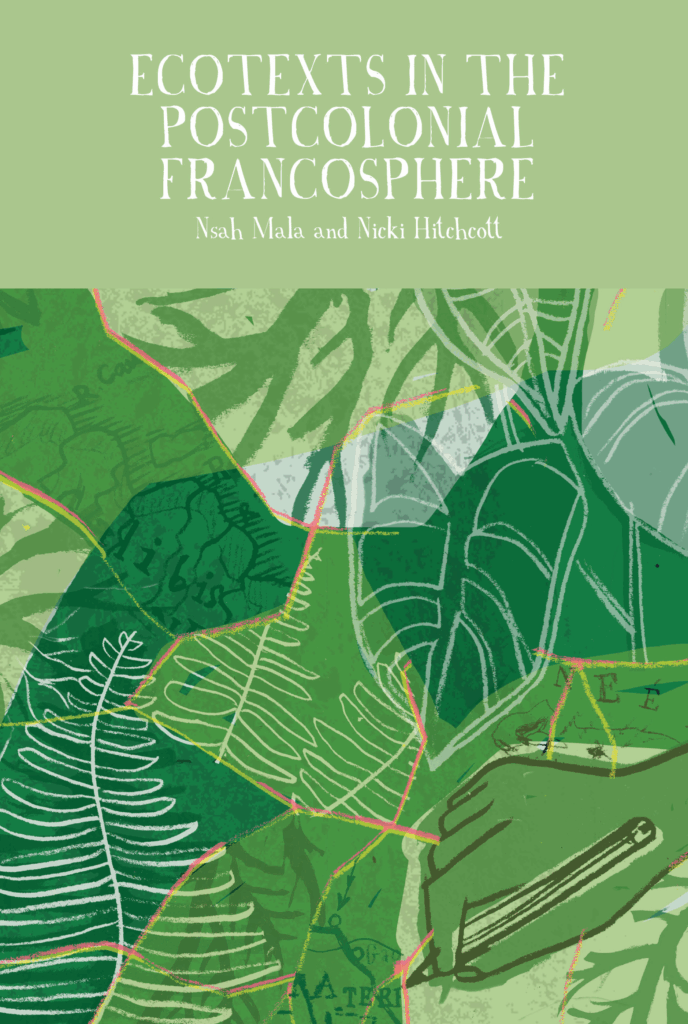
Published in June 2025. For more information see here:
https://www.liverpooluniversitypress.co.uk/doi/book/10.3828/9781836243144
New visiting scholar- Dr Sumitava Mukherjee
16 June 2025
We would like to introduce you to Dr Sumitava Mukherjee, a Visiting Scholar who we are hosting at the Global Research Centre for Diverse Intelligences throughout June 2025 (until 30 June).
Please find some information about Sumitava below. Feel free to cascade this information to your networks and among any relevant colleagues/postgraduates.
Dr. Mukherjee is an Associate Professor at the Department of Humanities and Social Sciences (HSS), Indian Institute of Technology (IIT) Delhi where he joined as an Assistant Professor in 2018, being associated with psychology and cognitive science. One of his research groups, Mukherjee GainLoss Lab studies the psychological valuation of gains versus losses and has advanced understanding of loss-aversion, which forms a foundational building block in behavioral economics and economic psychology. His other research group, WaterThoughts uses decision research and behavioral science to develop psychological perspectives and insights on water. Mukherjee was one of the founding faculty members of the Cognitive Science Programme at IIT Delhi.
Sumitava can be reached via [email protected] or [email protected]
St Andrews Environmental Humanities Network Launch Event
Environmental Humanities Network launch event
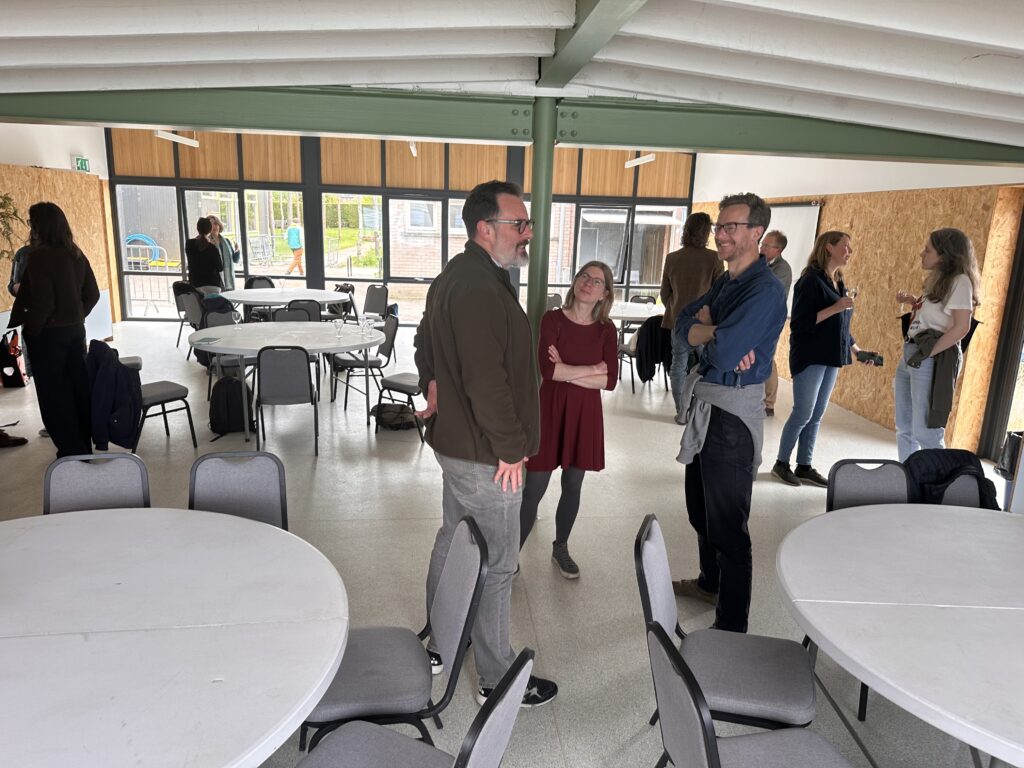
Staff and students gathered in the Boiler Room at the St Andrews Botanic Gardens for the launch event of the newly established St Andrews Environmental Humanities Network. Hosted by Catherine O’Leary, AVP Dean of Arts and Divinity and member of the steering group for the network, the event provided an opportunity for stakeholders from across the University to share ideas, make connections, and learn about the Scotland-wide environmental humanities landscape.
Welcoming the group, Catherine acknowledged the support of Ineke DeMoortel, Master of the United College, Dr John Clark in the school of History, the former StACEES group, network steering group members, and environmental humanities intern, postgraduate student Frances Bickerstaff for her work on website development and communications.
“We want to create a space for interdisciplinary studies that encourages collaborative partnerships not only within the humanities, but across the science, technology, engineering and maths fields,” said Catherine.
‘We know these collaborations are already taking place at the University, building on the long history of Environmental History at St Andrews, and the aim of the network is to bring all these together under one umbrella. This will also support connections to the broader environmental humanities landscape across Scotland, including the Scottish Arts and Humanities Alliance (SAHA),” she added.
Jason König, professor in the school of Classics and steering group member, elaborated on the growing field within Scotland, noting several peer institutions are also developing their own networks, including Aberdeen, Edinburgh, and Glasgow universities.
“We are placed particularly well at St Andrews for an environmental humanities network, given our geographical location which gives direct access to varied ecosystems rich for research across the breadth of disciplines across the University,” he stated.
“The Botanic Gardens is also ripe for interdisciplinary work, with several projects currently underway,” he added, noting the new partnership with Corrour in the highlands now adding another dimension to research opportunities.
The network launch inspired ideas from the group and suggestions included offering expert-level talks to enrich understanding of adjacent fields, development of a climate-fiction reading group, and inviting guest speakers to the University.
Colleagues who were unable to make the event and who are interested in learning more are encouraged to visit the Environmental Humanities website and sign up for the mailing list to keep in touch.
LAUNCH EVENT for the St Andrews Environmental Humanities Network
07 May 2025, 3pm- St Andrews Botanical Gardens, The Boiler House
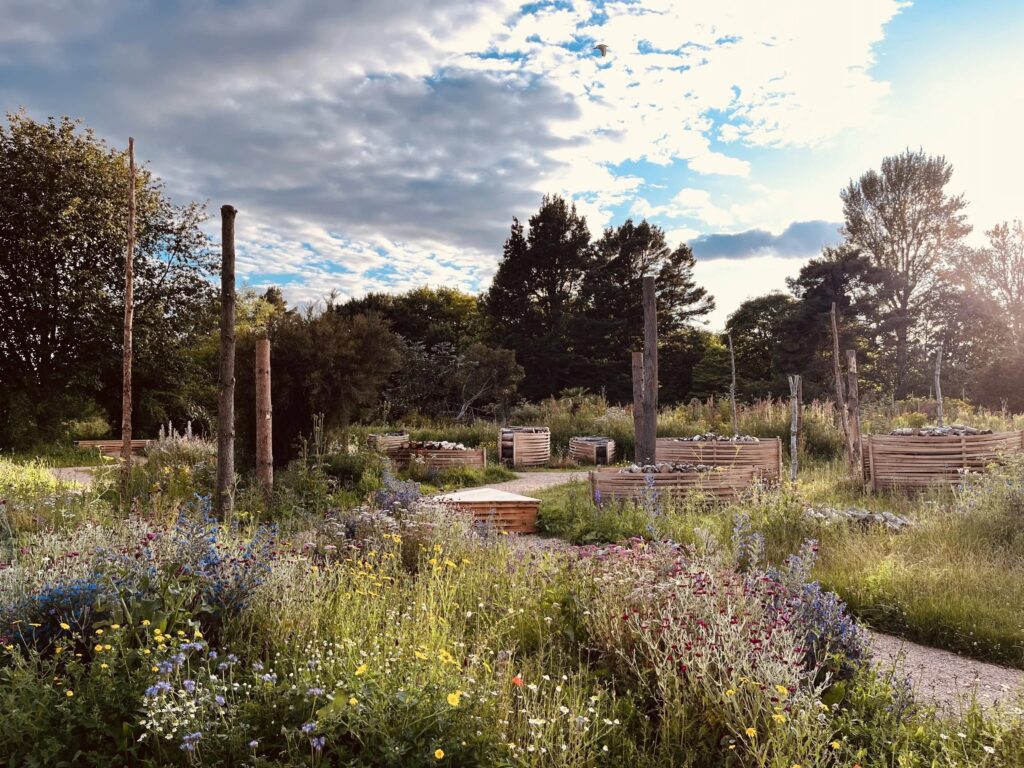
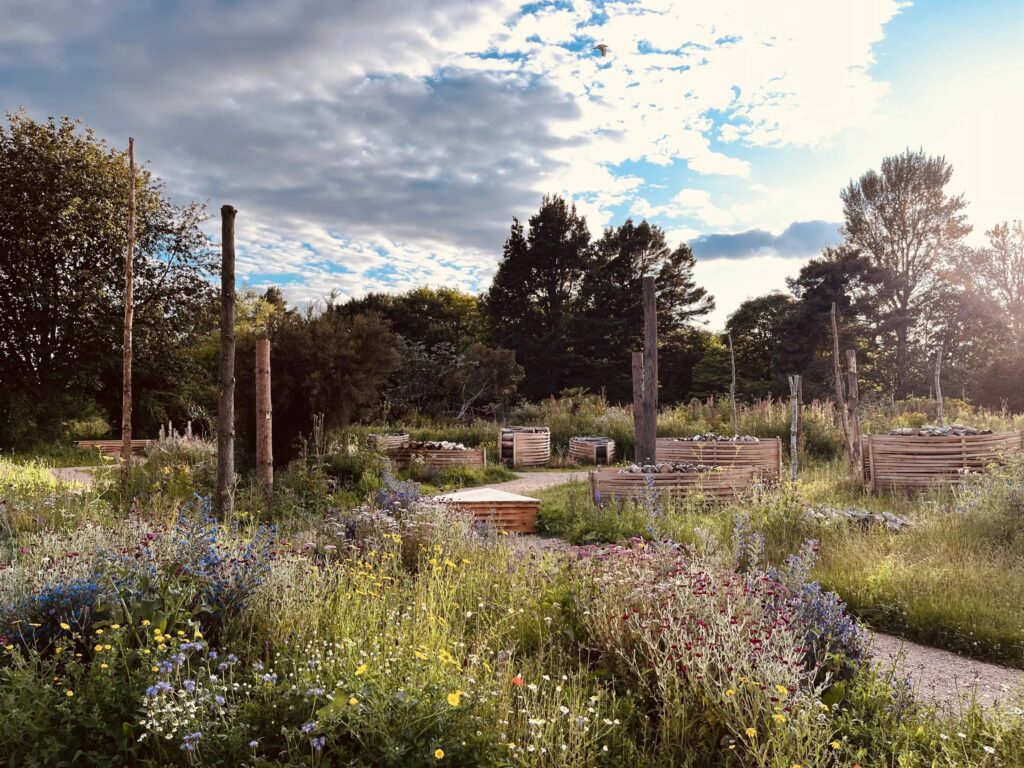
We will be holding an event to celebrate the launch of the network at the St Andrews Botanical Gardens. All staff and students are warmly invited to attend!
‘Anthropocene Mobilities in Contemporary Art – Exploring a Movement-Oriented Lens in Times of Ecological Crisis’
16 May 2025: Anne-Sophie Daffertshofer, research postgraduate student in the School of Art History, has successfully defended a doctoral thesis entitled ‘Anthropocene Mobilities in Contemporary Art – Exploring a Movement-Oriented Lens in Times of Ecological Crisis’
Starting from Trash: ‘Waste’ and ‘Wastework’
The Environmental Humanities network and the School of Art History are pleased to announce two new publications edited by Francesca Borgo (Lise Meitner Group Leader, Bibliotheca Hertziana; School of Art History, University of St Andrews) and Ruth Ezra (School of Art History, University of St Andrews):
“Waste,” a special issue of West 86th: A Journal of Decorative Arts, Design History, and Material Culture 31.1 (Spring–Summer 2024), showcases interdisciplinary and transhistorical scholarship. Moving from the premodern workshop to the contemporary mine, art historians, sociologists, artists, and scientists reconceptualize waste materials in the archive as in our present moment.
Wastework: Early Modern Stories from the Cutting Room Floor is a companion volume of collected essays, focused on the early modern period (1400–1800). Drawing from the fields of discard studies and ecomaterialism, contributors test the usefulness of contemporary formulations – secondary product cycles, material fatigue, metabolic flows, sustainability, recycling – while also proposing new categories with which to reimagine the discarded past. The book is the first to appear in the new editorial series DIS/APPEARANCE (Officina Libraria), which will explore different types of loss in the early modern period and is edited by Borgo’s multi-year Lise Meitner Research Group, “Decay, Loss, and Conservation in Art History.”
