
Past Events
These are some of the events, relating to Environmental Humanities, that have already taken place across the university.
Ancient Environmental studies: Interdisciplinary Approaches
A three-hour online workshop introducing ancient environmental studies through archaeology, palaeoenvironmental data, and ecocriticism.
Monday March 9th. 10am- 1PM. Online.
This three-hour online workshop offers a broad introduction to ancient environmental studies. It focuses especially on the ancient Mediterranean, but is intended to be applicable to other premodern periods and cultures. All welcome: the seminar is designed to be accessible to students in all arts and humanities disciplines, and we would actively welcome a range of different perspectives. The workshop deals in turn with environmental archaeology, palaeoenvironmental history (including discussion of approaches to dealing with palaeoscientific data), and ecocritical approaches to ancient literature and culture. We will cover some key publications and approaches in all three areas. The seminar will include some time for discussing a small number of readings set in advance.
Reserve your free ticket here.
Treasures from the Deep: A Lunchtime Talk with Dr Elsje van Kessel on Art and the Ocean
An exploration of seaweed in the context of the history of art and the oceans.
Wednesday January 28th 2026. 12:30PM-1:30PM. St Andrews Botanic Garden, Canongate, St Andrews KY168RT.
About the Speaker: Elsje van Kessel is an art historian specialising in western European art in a global context during the sixteenth and seventeenth centuries. Her work is driven by the question how people in the past gave meaning and attributed value to works of art and material culture at the time they were made and long afterwards. She has published extensively on art in Renaissance Italy, particularly Venice, and on the long history of display. Her current research focuses on the circulation of art objects on the early modern oceans, and she teaches various modules in relation to this work.
She is currently working on my second monograph, which focuses on the oceanic journeys of early modern art objects, especially those travelling within the Portuguese maritime empire. What happened to objects on board ships when they crossed the dangerous oceans, and how did their fates intersect with early modern empire-building, colonisation, and the extraction of resources? This project has received generous support through fellowships at the Netherlands Institute for Advanced Study and the Leverhulme Trust.
Tickets for this event can be purchased here.
Treasures of the Deep Book Club – The Seaweed Collector’s Guide
Conversations exploring seaweed as both a biological material and a medium for reflecting on environmental, social, and feminist issues.
Thursday January 15 2026. 6pm- 7:30pm. St Andrews Botanic Garden, Canongate, St Andrews KY168RT.
A beautifully illustrated little book that will open your eyes at the seaside. In this session, ‘The Seaweed Collector’s Guide’ by Miek Zwamborn will be discussed.
Seaweed is so familiar and yet its names – pepper dulse, sea lettuce, bladderwrack – are largely unknown to us. In this short, exquisitely illustrated portrait, the Dutch poet and artist Miek Zwamborn shares her discoveries of its history, culture and use, from the Neolithic people of the Orkney Islands to sushi artisans in modern Japan. Seaweed troubled Columbus on his voyages across the Atlantic, intrigued von Humboldt in the Sargasso Sea and inspired artists from Hokusai to Matisse. Covering seaweed’s collection by Victorians, its adoption into fashion and dance and its potential for combating climate change, and with a fabulous series of recipes based around the ‘truffles of the sea’, this is a wonderful gift for every nature lover’s home.
Minimum age 18. The entrance fee covers access to the garden, as well as tea, coffee, shortbread, and water. Please bring your own reading/writing materials. Free RSVP for those with existing admission tickets for this date, students and Friends Members. More information about the event and reserving a place can be found here.
It’s Only the End of the World Book Club – Oryx & Crake
Conversations on moments of profound change, and how literature helps us to question, reflect and reimagine what might come after the end. Ecocritical literature. The intersection of the written word and the natural world.
Wednesday 17 December 2025. 6pm-7.30pm. St Andrews Botanic Garden, Canongate, St Andrews KY168RT.
Margaret Atwood Oryx and Crake (MadAddam Trilogy)
The first volume in the internationally acclaimed MaddAddam trilogy is at once an unforgettable love story and a compelling vision of the future—from the bestselling author of The Handmaid’s Tale and The Testaments.
Snowman, known as Jimmy before mankind was overwhelmed by a plague, is struggling to survive in a world where he may be the last human, and mourning the loss of his best friend, Crake, and the beautiful and elusive Oryx whom they both loved. In search of answers, Snowman embarks on a journey—with the help of the green-eyed Children of Crake—through the lush wilderness that was so recently a great city, until powerful corporations took mankind on an uncontrolled genetic engineering ride. Margaret Atwood projects us into a near future that is both all too familiar and beyond our imagining.
Themes: Environmental Collapse and the Anthropocene, Genetic Engineering and Ecological Impact, Environmental Commodification and Exploitation, Human-Nature Relationship, Loss of Biodiversity and Ecological Memory
Minimum age 18. Please bring your own reading/writing materials. The entrance fee covers access to the garden, as well as tea, coffee, shortbread, and water. Free RSVP for those with existing admission tickets for this date, students and Friends Members. Purchase tickets here.
Centre for Energy Ethics Virtual Reading Group: Decay and Remediations
Session two of a six part series (November 2025-April 2025)
Wednesday December 17 2025. 3 -4.30pm. Virtual.
During the first 30 minutes, the group will discuss readings based on pre-circulated discussion questions. During the second 30 minutes, participants will spend silent time crafting a creative response (e.g., drawing, collage, knitting, poetry, etc.) to the readings, a process inspired by the “Extracts” reading group at UCD Humanities Institute. During the final 30 minutes, participants will share and discuss their creative responses.
Sessions will be moderated by Dr Camille-Mary Sharp and/or guest moderators. Reading list and registering link can be found here.
ASLE-UKI Seminar – Ecopedagogy as Method: Knowledge, Practice, and Transformation
Friday 12 December 2025. 4-5.30pm. Online event.
This roundtable explores ecopedagogy as both a framework and a practice for imagining institutional and pedagogical transformation in higher education. The session will consider how ‘eco’ might be conceptualised not only as environment, but as relation, practice, and method. Taking into account the recurring institutional debate on “Education for Sustainable Development”, participants will reflect on what it means to treat pedagogy itself as an ecological activity, through dialogue and examples from teaching across the humanities. Finally, the roundtable will address the constraints and possibilities shaped by institutional pressures, and consider how ecopedagogy might help us reimagine the university as a more sustainable, relational, and transformative space.
Speakers
Laura Albertini (University of St Andrews)
Hugh Dunkerley (University of Chichester)
Petra Hansson (Uppsala University)
Jasmin Kirkbride (University of East Anglia)
Registering link can be found here.
“Rannoch Moor as Watershed: Mind and Nature in Scottish Art”
A Lunchtime Lecture as part of our Seeds of Thought series with speaker Murdo Macdonald.
Wednesday 10 December 2025. 12:30pm to 1:30pm. St Andrews Botanic Garden, Canongate, St Andrews KY16 8RT.
Murdo Macdonald is author of Scottish Art (Thames and Hudson, 2000, 2021), Patrick Geddes’s Intellectual Origins (Edinburgh University Press, 2020), and Ruskin’s Triangle (Ma Bibliothèque, 2021). Recent chapters include ‘Robert Burns and the Visual Arts: Portraiture, National Landscapes, and the Context of Monuments’ in The Oxford Handbook of Robert Burns, (Oxford University Press, 2024) and ‘A basis for Celtic Revival Art in Scotland’ in Irish and Scottish Art, c. 900–1900: Survivals and Revivals (Edinburgh University Press, 2024). He is professor emeritus of History of Scottish Art at the University of Dundee, an honorary member of the Royal Scottish Academy, and an honorary fellow of the Association for Scottish Literature.
About Seeds of Thought:
Over the coming months, we invite you to a menu of fascinating ideas over lunch. In our talks, we invite speakers whose research explores our relationship to time and place through a variety of disciplines, ranging from biology, geology, and anthropology to art history or architecture: together, we consider the forces that shape life on our world and beyond, and ways of engaging with environmental shifts on various scales in both practical and imaginative ways.
Coffee, tea, and water will be available, with sandwiches for pre-order at the Visitor Centre. Free for St Andrews Botanic Garden Friends Members, £3 for visitors Get tickets here.
Book Launch – Carbon Capital: climate change and the ethics of oil investing
Thursday 4 December 2025. 2 to 4PM. St Andrews. Muir Seminar Room, OBS109C, KY16 9LB.
Join CEE Director of Policy Dr Sean Field in celebrating the release of his new book; Carbon Capital.
This event can attended in person or online. Get tickets here.
Biodiversity Action Plan: update with the working group
The purpose of the Biodiversity Working Group is to write and update the University Biodiversity Strategy and the University Biodiversity Action Plan. We also facilitate and carry out the actions of the University Biodiversity Action Plan.
Tuesday 2 December 2025. 1pm to 4pm. Bute Building, Lecture Theatre D.
Learn more about ways to get involved in practical activity for nature across the University, and hear from those who have been working on actions throughout the year. You do not need to be an expert to get involved, your participation is what matters.
From 1pm to 2pm, there will be an informal chat with others who are interested in actions for biodiversity, including members of the Biodiversity Working Group. From 2pm to 4pm, there will be a workshop and Action Plan update. We will work in groups to go through the current Action Plan, discuss progress and changes needed, and assign responsibilities. This is your opportunity to get involved in actions for nature.
All staff and students are welcome to join the Biodiversity Working Group’s annual update of the Biodiversity Action Plan.
‘Indexed Beings’ Film Screening + Artist Talk co-presented w/ Forgan Arts
Join us for a screening of ‘Indexed Beings’, followed by an artist talk with Helen Knowles and Soraida Chindoy.
Saturday 29 November 2025. 6pm to 8.30pm. St Andrews Botanic Garden, Canongate, St Andrews KY16 8RT.
What happens when plants are no longer treated as specimens, but as sentient beings capable of knowing, acting, and creating their own worlds. How might this transform the production of scientific knowledge?
Indexed Beings is the second in a trilogy of artist films by Helen Knowles, developed through her practice-based PhD at Northumbria University. Filmed in Mocoa, Putumayo, Colombia, the work was made in partnership with members of the indigenous Kamëntsá, Inga, Cofan and Siona communities and the Herbario Etnobotánico del Piedemonte.
The 42-minute film centres on the re-enactment of a dispute that took place in the Herbarium of Piedemonte, Mocoa, in the Colombian Amazon, between a scientist and a local taita (shaman) over the role of the herbarium. For the scientist, it is a vital tool to defend territory from exploitation and protect its biodiversity; for the taita, plants are autonomous, intelligent beings that cannot be catalogued. Through performance, collaboration and dialogue, Indexed Beings explores plant sentience and asks how knowledge shifts when we recognise more-than-human intelligence, asking whose knowledge really counts?
The screening will be followed by a conversation with artist, Helen Knowles and collaborator and participant in the film Soraida Chindoy Buesaquillo, an indigenous guardian, mother and activist who is working to defend the sacred Putumayo mountains.
To increase accessibility, we have chosen a sliding scale for our ticket prices. If you can afford a full-price ticket, and would like to support others to attend, please choose an upper-tier “pay it forward” ticket. If you would like to attend, but affording a ticket is a barrier, please contact Anne ([email protected]) to register for a free of charge ticket. All donations and ticket sales are essential in allowing us to continue offering events such as these – we’re grateful for all our supporters who attend our events and are advocates for our work. Get tickets here.
A Space For Hope
A collaborative interactive installation on climate hope – hosted at St Andrews Botanic Garden.
Workshop: Thursday 27 November, 6:00 – 7:30pm. Installation: Saturday 29 November, 12pm, 1pm, 2pm, 3pm. St Andrews Botanic Garden, Boiler House.
Join us in making A Space for Hope, an interactive installation which seeks to create space for climate hope amongst increasing climate anxiety. This interactive installation will involve documentary footage, guided movement and creative writing, to encourage reflection on our shared fears and hopes for the future. The Thursday workshop will be an extended version of the installation and audience members will play an active role in shaping the final form of the installation. Audience members are welcome to both the workshop and the installation itself.
The installation is a collaboration between ShyBairn Theatre, Alucinari productions, Aura CuriAtlas Physical Theatre and the University of St Andrews’ School of Geography and Sustainable Development. ShyBairn Theatre create theatre projects that seek to contribute to social change. The company’s previous projects include This is What Utopia Looks Like, which ran at St Andrews Botanic Garden in November 2024.
Adrian Fisk, of Alucinari productions, is a prolific photographer and documentary filmmaker, whose work explores a range of topics, including social justice, environmentalism and climate action. Professor Joan Gavaler, Director of Aura CuriAtlas Physical Theatre, has created 85 original works and uses guided movement to support healing.
The installation is funded through a University of St Andrews STAIRS Nascent Partnership fund, with additional funding from the School of Geography and Sustainable Development.
Please book tickets for the free event through Eventbrite.
Seeding New Ideas: Celebrating Sustainability in the Curriculum
An event centering education led by the Sustainability in the Curriculum Committee.
Wednesday 19 November 2025. 2:00pm to 4:00pm. Arts Building, Arts Lecture Theatre.
The Sustainability in the Curriculum Committee is running an event to share good practice, develop capacity and celebrate our Golden Dandelion Awards in education for sustainable development.
This workshop will include an introduction around current innovations in education for sustainable development, examples of good practice from our community, a discussion on knowledge integrity and digitalisation, and presentation of Golden Dandelion Awards for the year 2024-2025. The Golden Dandelion is awarded for excellence in education for sustainable development.
All staff and students are welcome. Please book a ticket for this free event. Get tickets here.
Scottish Research Alliance for Energy, Homes and Livelihoods
Wed 10 Sep 2025 9:30 AM – 5:30 PM, Dynamic Earth Edinburgh
The Energy, Homes and Livelihoods Annual Event will unite local authorities with diverse resources and needs, along with experts from academia, industry, government, and local communities to share knowledge, discuss trends and challenges, and provide networking opportunities.
The objective is to inspire, educate, and empower participants to apply this knowledge in future research collaborations to drive success.
Rewrite the Future
a new, free, Museum Exhibition and Events Programme that will run May 28th – 5th September in the Wardlaw Museum with events across Fife. It aims to get visitors to consider what the future may look like and what role they may play in writing it. The programme is a collaboration led by the Museums and Libraries Team and members of the St Andrews Centre for Critical Sustainabilities (StACCS). The exhibition will feature the work of colleagues from across the University, including Dr Mara Van Der Lugt, Dr Loraine Clark, Dr Harry Watkins/Studio Biocene, Dr David Herd, Dr Alan Miller, Dr Jessica Hope, Justin Lorenzo Biggi, Maria Andrei and Dr Louise Reid; for information about all the contributors please see: Partners – Rewrite the Future
Constructing autonomy and socio-territorial governance in the Wampis Nation’s territory of life
26 June 2025– Edgecliff, GO3
The Nettle Project – embracing slow textile craft to promote interdisciplinary thinking about sustainable development.
19 June 2025- Postgraduate Workshop Series- Old Burgh School, 108 – Lumsden – Seminar Room 1 (5:00-6:15pm)
Speaker: Bridget Steenkamp (Roehampton)
All staff and students welcome to attend.
Arts of attentiveness in the sciences and humanities: reimagining learning in, with, for and about nature
12 June 2025-Postgraduate Workshop Series- Old Burgh School, 108 – Lumsden – Seminar Room 1 (5:00-6:15pm)
Speaker: Ben Ong
With the caveat that ‘nature’ is a slippery and contested term, here I use it in the practical, common-usage sense of the environment, habitats, ecosystems and biodiversity, particularly where the non/other-than-human are concerned. When interdisciplinary collaborations across the sciences and humanities occur, they tend to involve experts in the sciences working with experts in the humanities. Rarer is the educational programme on nature and the environment, at undergraduate level or earlier, that is informed in equal parts by the sciences and the humanities. Are there examples of such crossovers? Should there be? This session aims to provoke thought and inspire response.
I’m an ecologist by training, but I’ve spent the better part of the last decade engaging with other disciplines. In this session, I will share insights from my work in environmental education, science communication and urban green space policy in Malaysia—where learning about nature typically happens in the sciences (which tend to remain separate from the humanities) and where science, despite its limitations, holds sway in influencing policy and public perception (and knowledge) of nature. With a focus on impact beyond academia, this session wonders if there is a case for rediscovering natural philosophy for environmental pedagogies, and if so, how it may come to be. Drawing on provocations from Greg Mannion (education, assemblage, New Materialism) and Thom van Dooren and Deborah Rose (lively ethography), we will reflect on what environmental education—or education for sustainable development, or environmental and sustainability education—could look like if it were more open to beyond-scientific traditions; if contemporary ecology reconnected with its qualitative roots; and if more-than-human approaches were more widely considered.
All staff and students welcome to attend.
Taking Care of Ourselves in Order to Take Care of the World
A workshop on climate emotions led by Professor Joan Gavaler
Wednesday 11th June-12.30pm – 2pm. (workshop 12.30 – 1.30pm, followed by free lunch 1.30 – 2pm). At the Boiler House, St Andrews Botanic Garden
This workshop uses contemplation, movement, and writing to process our responses to climate change and connect to the present moment. Participants explore pausing, sensing, rooting, and expanding. What personal and communal strength can we access to better face the realities of climate change? We acknowledge there are people and financial/political power structures that value extracting resources over human and planetary well-being. We acknowledge harm is inequitable and heartbreaking. Gathering a critical mass of people toward healing action is an ongoing challenge. Through this workshop we will embody the process of being present to care for ourselves, other people, and the world when things fall apart. We cultivate presence to respond flexibly to each moment, each need, and each opportunity to shift our society in a different direction.
Free event, all welcome. Book a place here
‘Soils for life: exploring how soils can contribute to archaeology and vice versa’
01 May 2025– Postgraduate Workshop Series- Old Burgh School, 108 – Lumsden – Seminar Room 1 (5:00-6:15pm)
Speaker: Meike van Lit (Glasgow)
LAUNCH EVENT- St Andrews Environmental Humanities Network
07 May 2025, 3pm- St Andrews Botanical Gardens, The Boiler House
The St Andrews Environmental Humanities network will celebrate its launch on May 7 at 3pm in the St Andrews Botanic Garden. All colleagues are warmly welcome to attend.
Workshop: Philosophy of Climate Science
06-07 May 2025
Please Register to attend with [email protected].
‘Evolutionary Evil, Ecohorror and the Aesthetics of Cognition: Is There An Aesthetic Solution for Nature’s Disvalue?’
08 May 2025-Postgraduate Workshop Series- Old Burgh School, 108 – Lumsden – Seminar Room 1 (5:00-6:15pm)
Speaker: Charlotte Forster (St Andrews)
All staff and students welcome to attend
The Himalayas as Empty Space? Colonial Legacies, Media Representations, and the Trekkers’ Experiences of Emptiness on the Annapurna Circuit
15 May 2025 -Postgraduate Workshop Series- Old Burgh School, 108 – Lumsden – Seminar Room 1 (5:00-6:15pm)
Speaker: Giovanni Masara (St Andrews)
All staff and students welcome to attend.
Gifts from the Land: Making Earth Pigments with Siobhan McLaughlin
17 May 2025- noon-4pm St Andrews Botanic Gardens
Join artist and curator Siobhan McLaughlin for an afternoon at St Andrews Botanic Garden, where you will explore the practice of creating earth pigments for painting. Link
It’s Only the End of the World Book Club – Cultivating the Arts of Noticing
May 21, 6pm – 7.30pm- St Andrews Botanic Gardens
In this session, we delve into van Dooren et al.’s Cultivating the Arts of Attentiveness, Anna Tsing’s The Arts of Noticing and Horticultural Appropriation by Claire Ratinon and Sam Ayre.
(Re)Visiting Lade Braes: the social, political and economic histories of our nonhuman neighbours
22 May 2025, 1pm or 2:15pm. Postgraduate Workshop Series- Old Burgh School, this is an interactive walk along the Lade Braes.
This seminar will be a slightly off-beat walkshop through different and distinct landscapes in St Andrews: St Mary’s Quad (the old Botanic Gardens), Cockshaugh Park and Lade Braes. These “gardened” landscapes are sites of multispecies political storytelling. They have been curated, contested, subverted, (re)imagined, seeded, rooted, uprooted and governed by a wildly diverse cast of actors: both human and non-human.
As we navigate the complexities of this climate crisis and are hurled further into this sixth mass extinction, we must learn what it means to meaningfully facilitate – or ‘garden’ – more viable landscapes. This walkshop, in a macroscopic sense, is an exercise in attuning to the political lives of our nonhuman neighbors, and in imagining them as co-conspirators and co-gardeners of alternative, more livable futures
Speaker: Minke Hijmans (St Andrews).
Seeds of Thought: A Lunchtime Talk with David Farrier on ‘Nature’s Genius’
May 28, 12:30pm – 1:30pm- St Andrews Botanic Gardens
Life on Earth is changing; the question is, can we change with it? Can we remake the world to be fit for all life to thrive once more?
Interdisciplinary beach clean and BBQ
29 May 2025
The Open Virtual Worlds group would like to invite participation in a summer Beach Clean and BBQ this Thursday 29th of May. All are welcome to join and the School is particularly keen to engage in interdisciplinary conversations aimed at promoting sustainable communities, quality education, and climate action.
Meeting at the School of Computer Science at 11:00 am for the beach clean and at 2:00pm for a sustainable bbq. While there, why not enjoy a visit to the School’s virtual reality exhibits? Guests can explore a Virtual Dive, featured in the Scottish Seabird Centre, or visit a Pre Clearance Highland Village, featured in the Timespan Museum, and check out Climate Futures for the Antarctic and Scotland.
Legal Persons/Legal Places : Land Communities in F.W. Maitland and Beyond
29 May 2025– Postgraduate Workshop Series- Old Burgh School, 108 – Lumsden – Seminar Room 1 (5:00-6:15pm)
Speaker: Poppy Kershaw
All staff and students welcome to attend.
Sustainabilities Stories: Workshop
29 May 2025, 12 noon-5.30.
The newly established St Andrews Centre for Critical Sustainabilities (https://staccs.wp.st-andrews.ac.uk/home/) has creativity as one of its key themes and is organising a small interdisciplinary workshop ‘Sustainability Stories’ on the 29th of May 12 noon-5.30. We see this event as the beginning of a conversation about how creativity, the arts and imagination – and especially narrative, storytelling and speculative fictions – are being/can be/should be at the heart of sustainability research and action.
The workshop will begin with an informal lunch and benefit from the shared expertise of an exciting external speaker. If you would like to participate you would need to come prepared to talk briefly about your own approach towards using story, fiction, and imagination in your work. For more information and to sign up, please contact Dr Louise Reid (StACCS co-Director): [email protected] by Wednesday 21st May.
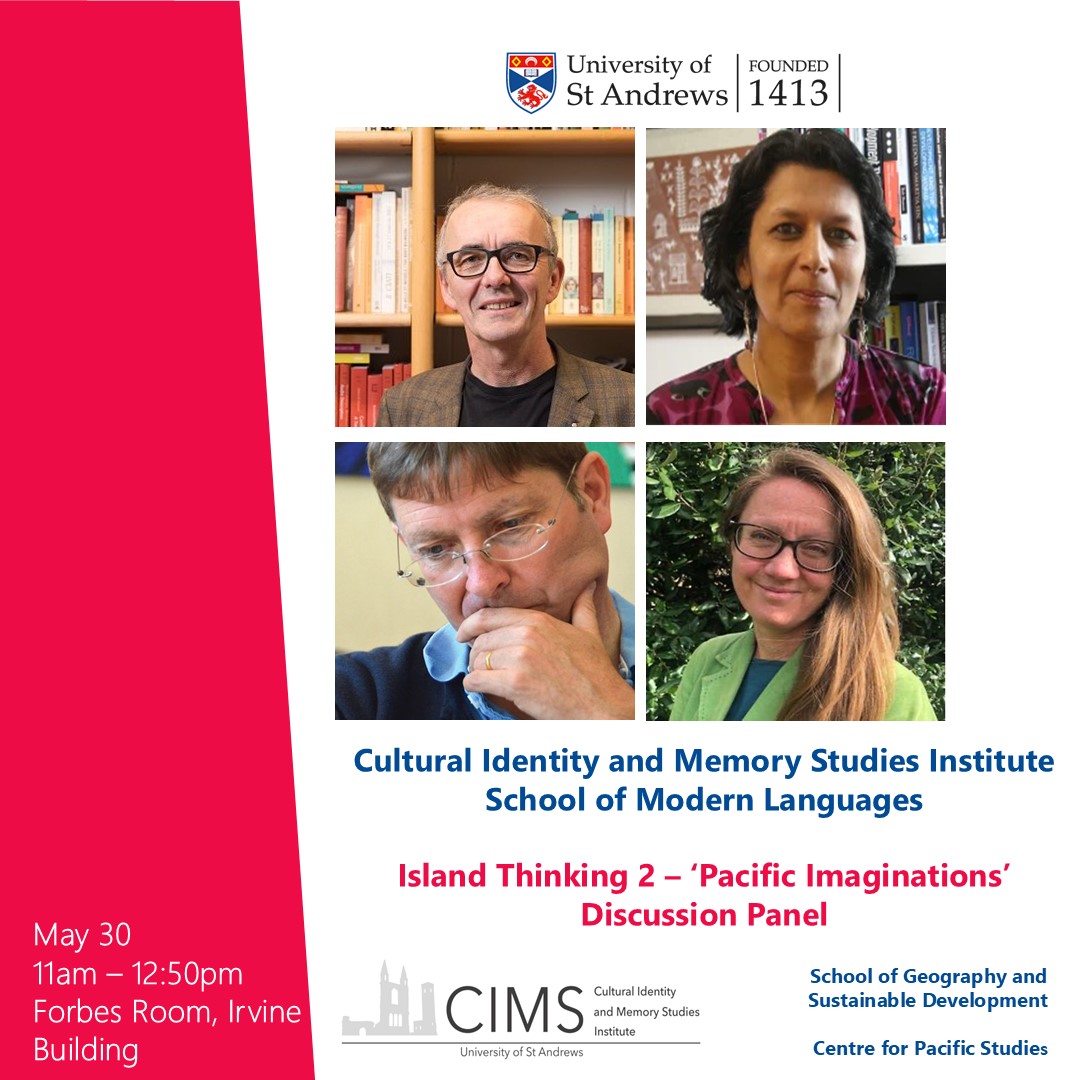
Island thinking 2 – ‘Pacific imaginations’ Discussion panel
Following the successful ‘Island Thinking 1’ panel last semester, as part of the second visit by Senior Global Fellow Prof Michael Cronin (Trinity College Dublin), we will be holding another discussion with Michael who will be joined by Professor Uma Kothari, from Manchester University and Prof Emma Sutton and Dr Tony Crook from St Andrews.
Friday May 30, 11am – 12:50pm-Forbes Room, Irvine Building
More information can be found on the Cultural Identity and Memory Studies (CIMS) webpage: https://cims.wp.st-andrews.ac.uk/seminar-series/
This event is hosted by the Cultural Identity and Memory Studies Institute (CIMS) in the SoML. This event also links to the School of Geography and Sustainable Development, the St Andrews Environmental Humanities network and the Centre for Pacific Studies.
Sacred and the sewage- the many facets of the Ganges as depicted in the Classical Indian Dance ballet Namamey Gange
05 June 2025- Postgraduate Workshop Series- Old Burgh School, 108 – Lumsden – Seminar Room 1 (5:00-6:15pm)
ONLINE EVENT-THIS SEMINAR WILL BE HELD ONLINE, PLEASE EMAIL envhum@ for the link
Speaker: Giri Raghunathan (Roehampton)
All staff and students welcome to attend.
Energy-in-Motion: Centre for Energy Ethics Conference
8-10 June, Dundee V&A
“Energy-in-Motion” is an interdisciplinary conference that brings together artists, researchers, activists and community members to learn, collaborate, and co-create around topics relating to climate emotion and energy futures. It is an international conference with a unique programme that features workshops, film screenings, panel discussions, performances, poetry, visual art, photography exhibitions and more. The conference will be run hybrid, with most sessions streamed online and many additional online resources and workshops that will suit a range of time-zones.
Please visit the CEE website for more information and to register. Registration closes May 23rd
